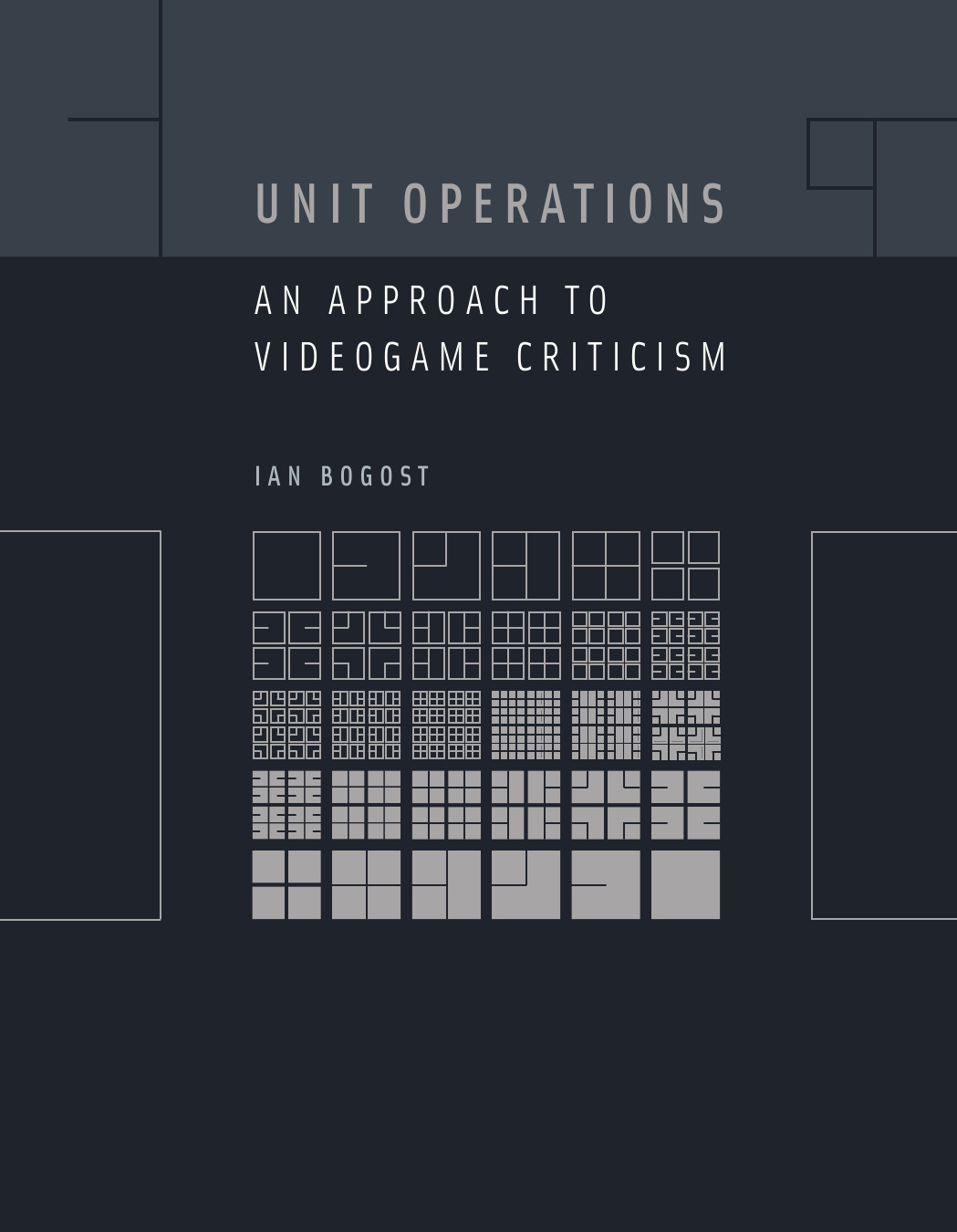
A book about comparative videogame criticism: games, philosophy, literature, and art.
In Unit Operations, I offer a new methodology for videogame criticism as well as a model for potential collaboration between the humanities and computation. I argue that similar principles underlie both literary theory and computation, and I suggest a literary-technical approach that can be used to analyze videogames and other software artifacts. Moreover, this approach can be applied beyond videogames: I suggest that any medium--from videogames to poetry, literature, cinema, or art--can be read as a configurative system of discrete, interlocking units of meaning (as unit operations), and I illustrate this method of analysis with examples from all these fields. The marriage of literary theory and computation, I argue, helps humanists take technology more seriously and help technologists better understand software and videogames as cultural artifacts.
Other themes covered include object technology, psychoanalysis, complex network theory, ludology and narratology, the question of "fun" in videogames, and the challenges of videogame study in the contemporary university.
Works discussed from philosophy include those by Plato, Badiou, Benjamin, Heidegger, Zizek, Derrida, Deleuze, Spinoza, Leibniz; from media theory including McLuhan, Bolter, Kittler, Landow, Manovich, Muray, Postman; from videogames including PONG, Half-Life, The Sims, Star Wars Galaxies, Grand Theft Auto, The Legend of Zelda, SimCity, Tetris; from literature including Baudelaire, Apollinaire, Artaud, Bukowski, Flaubert, Joyce; from film including Spielberg, Jeunet; from science including Wolfram, Barabasi, Dawkins, Gell-Man, Granovetter and many others in all these domains.
The table of contents and sample chapters are available on my publisher's site.
Department of Telecommunications, Indiana University
author of Synthetic Worlds: The Business and Culture of Online Games
"Unit Operations is a major milestone on the path to establishing a framework for analyzing videogames as important cultural artifacts of our time. Proposing a comparative approach to videogame criticism that is equally relevant for humanists and technologists, Ian Bogost weaves philosophy, psychoanalysis, literature, film, media theory, informatics, software, and videogames into a narrative that reveals how these seemingly disparate fields relate to and inform each other. Unit operations--discrete, programmatic units of meaning--are used as the conceptual tool for unpacking complex relationships between different worlds: criticism and computation, genetics and complex adaptive systems, and narrative spaces from Casablanca and Half-Life to Ulysses and Grand Theft Auto."
Adjunct Curator of New Media Arts
Whitney Museum of American Art
- One of 50 Books for Everyone in the Game Industry, according to industry veteran Ernest Adams
- Review in the Teachers College Record (Sep 2006), by Gillian "Gus" Andrews
- Review by Zach Whalen, Gameology.org
- Review by Darshana Jayemanne, Gameology.org
- Review by Christothea Herodotou, Game Research
- Review by Joris Dormans
- Review in Afterimage (Jan/Feb 2007), by Ilana Swerdlin
- Review in The Sociological Review (55:1, Feb 2007), by Alex Wade
- Review at Infodad: Family Focused Reviews
- Review in Literary and Linguistic Computing, by Stephen Ramsay
- Review by Jeremy Bushnell
- Review at GamePolitics, by Jeff McHale
- Interview at Videoludica with Matteo Bittanti, about the book and game criticism
- Review in Edge Magazine, July 2006
- Interview in Game Face Magazine
- Review and reactions by Matt Peckham
- Review and comments by Jason Mittell
- Review by Terry Schenold, Resource Center for Cyberculture Studies (my response)
- Neural 30
- Review by Emily Short, Electronic Book Review